Mowgli
The Jungle BookMowgli is the human child adopted into the Seeonee Wolf Pack and raised among the Free People. Found alone at night in the jungle, he is defended by Raksha, trained by Father Wolf, taught by Baloo and Bagheera, and eventually forced to acknowledge that his human nature both empowers him within the jungle and separates him from it. His decisive significance lies in this double belonging: he can master the jungle’s language and laws, yet cannot remain wholly within the society that made him.
Identity and Introduction
Mowgli first appears not as a conventional human hero but as a vulnerable, naked child who has wandered into a wolf’s cave. Father Wolf prepares to spring when the bushes rustle, then checks his leap in mid-air after seeing the child. The baby clings to a low branch, looks into Father Wolf’s face, and laughs instead of showing fear. Father Wolf identifies him as a man’s cub, while Mother Wolf, who has never seen such a creature, orders that he be brought closer.
The child’s first defining traits are therefore physical fearlessness and immediate adaptability. He is soft, hungry, and barely able to walk, but he does not behave like prey before the wolves. Mother Wolf sees that he has already pushed one of her own cubs aside, a small gesture that becomes evidence of his will to survive. She names him Mowgli the Frog because of his hairless, human appearance and because he has entered the wolf den from outside their familiar order.
Mother Wolf’s decision to keep him is also a declaration of protection against Shere Khan. She argues that the tiger would have killed the child and then fled toward the Waingunga River while the villagers searched the wolves’ lairs in revenge. Her defense joins affection with political judgment: sheltering Mowgli saves an apparently helpless child, but it also denies Shere Khan an easy victim and prevents the tiger from dictating the Pack’s conduct.
Adoption and Education
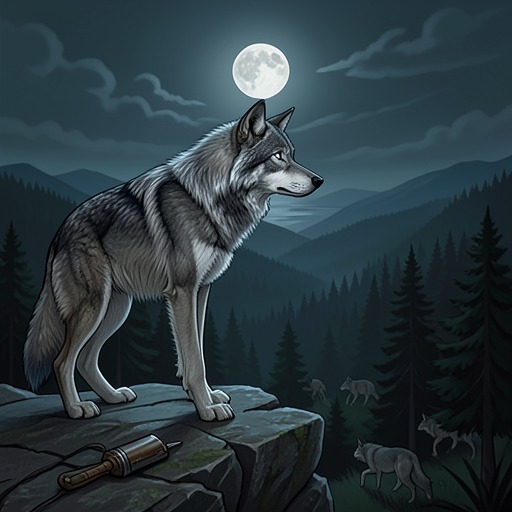
Mowgli’s acceptance is governed by the institutional rules of the Seeonee Wolf Pack rather than by sentiment alone. The Law of the Jungle requires wolf cubs to be presented before the Pack Council at the full moon so that the adults can identify them; once recognized, the cubs may run freely, and a grown wolf who kills one is subject to death. Because Mowgli is not a wolf, his position requires special defense, but the Council ultimately admits him into the Seeonee Wolf Pack for the price of a bull and on Baloo’s good word.
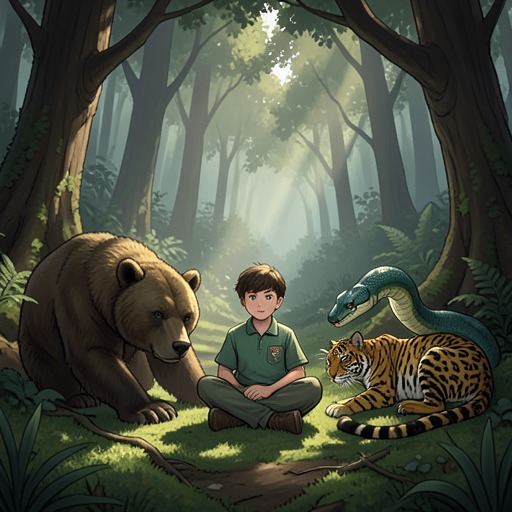
His upbringing is compressed into a remarkable gap of ten or eleven years, but the details supplied about that interval show how thoroughly the jungle becomes his education. Father Wolf teaches him the practical work of survival and the meanings of jungle signs. Every rustle in the grass, breath of warm night air, owl note, bat’s claws, and splash of a fish becomes legible to him. Mowgli does not merely live beside animals; he acquires their sensory knowledge and treats the forest as a language-filled environment.
Baloo teaches him that honey and nuts can be as pleasant to eat as raw meat, while Bagheera teaches him to climb. At first Mowgli clings to branches like a sloth, but he later moves through them nearly as boldly as a gray ape. He swims in forest pools when hot or dirty, climbs for honey, sleeps in the sun, and learns through repeated bodily practice rather than abstract instruction.
Mowgli also participates in the Pack’s social life. At Council Rock he discovers that a hard stare can force a wolf to lower its eyes, and he uses this power for amusement. At other times he removes thorns and burs from wolves’ paws and coats, turning his human hands into a practical service for his animal companions. He visits the cultivated lands at night and studies the villagers in their huts, but Bagheera’s demonstration of a concealed drop-gate trap gives him a lasting mistrust of men.
Power, Conflict, and the Red Flower
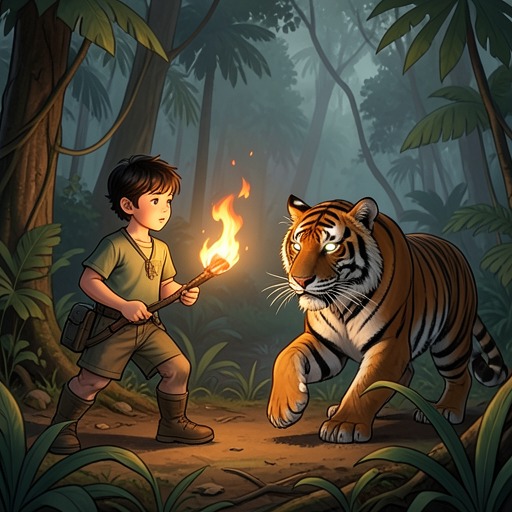
Mowgli’s position changes when the Pack’s internal order collapses around Akela. He confronts the wolves with the Red Flower, the jungle’s name for fire, and uses it as a human instrument of authority. Fire does not make him a wolf; it reveals the power of the difference that has always separated him from them. In his hands it becomes a means of defending Akela, confronting Shere Khan, and forcing the wavering wolves to recognize that their supposed independence has become cowardice.
Mowgli drives Shere Khan back with the burning branch, reminding the tiger that the promised killing at the Council will not occur on Shere Khan’s terms. He declares that when he next comes to Council Rock as a man, he will come with Shere Khan’s hide on his head. He also orders the wolves not to kill Akela, asserting that Akela will live because Mowgli wills it. The scene reverses the Pack’s hierarchy: the adopted outsider becomes the figure who commands, while the wolves who once judged his membership are driven away as dogs.
Yet triumph immediately exposes the cost of his power. After the wolves scatter, Mowgli begins to sob and asks whether he is dying because he does not understand tears. Bagheera explains that tears are what men use and tells him that he is now a man rather than a man-cub. The emotional discovery is more decisive than the weapon itself. Mowgli can command the jungle for a moment, but he cannot erase the human nature that makes the jungle inaccessible to him.
Shere Khan’s Death and Its Consequences
Mowgli later engineers Shere Khan’s death through a buffalo stampede. He turns Rama and the herd toward the wallows while Akela and Gray Brother scatter the buffaloes and prevent them from trampling one another. Shere Khan receives no further opportunity to fight: he is dead beneath the herd, and the kites are already approaching.
Mowgli treats the death as both revenge and unfinished work. He describes it as a dog’s death because Shere Khan never would have shown fight, then reaches for the knife he now carries in a sheath around his neck while living with men. His objective is not merely to kill the tiger but to claim the hide for Council Rock, fulfilling the promise made when he confronted Shere Khan with the Red Flower.
The skinning scene underscores Mowgli’s hybrid expertise. A boy trained among men would not ordinarily know how to skin a ten-foot tiger, but Mowgli understands the structure of an animal’s hide. He works for an hour, slashing and tearing while the wolves assist at his command. Buldeo arrives with a Tower musket after hearing from village children about the buffalo stampede, but the wolves disappear when they see the man. Mowgli’s competence belongs fully to neither society: it is human enough to use a knife, animal enough to understand a tiger’s body, and politically charged enough to return Shere Khan’s hide to the place where his belonging was once contested.
Change, Separation, and Narrative Significance
Mowgli’s trajectory is a repeated movement between adoption and exclusion. Raksha’s first defense gives him a family; the Pack’s recognition gives him a social identity; Father Wolf, Baloo, and Bagheera give him knowledge; and his command of fire gives him temporary supremacy. But none of these achievements resolves the contradiction of his existence. The same human difference that makes him dangerous to Shere Khan and powerful before the wolves also prevents him from remaining simply one of the Free People.
His tears mark the inward turning point of this story. Before that moment, Mowgli understands the jungle through action: he hunts, climbs, swims, stares down wolves, removes thorns, and uses fire. After the Pack’s rejection, his body reveals an experience that he cannot translate into the jungle’s categories. Bagheera’s explanation names the boundary that Mowgli has been approaching throughout his upbringing: he is not becoming a wolf but becoming conscious of being human.
The character’s significance extends beyond the Mowgli episodes in which he is central. The book repeatedly places animal communities under pressure from human violence and human systems. Kotick witnesses men clubbing seals and searches the seas for a safe rookery; the camp at Rawal Pindi gathers men, camels, elephants, horses, bullocks, and mules under military command; and an old Central Asian chief is told that the animals obey because an order was given. Against these scenes, Mowgli offers a more intimate crossing of the human-animal boundary. He is neither a distant observer of animals nor a human master who merely commands them. He is formed by animal society, acts with animal knowledge, and is finally separated from it by the very humanity that enables him to wield fire, carry a knife, and choose his own allegiance.